Unlock the power of smarter business and faster decision-making with integrated ERP platforms that bring data, processes, and real-time business insights together.
ERP is transforming from a record-keeping system to the coordination layer from which business operations, partner management, and performance interpretation are managed. As your business grows, disparate applications, manual data transfer, and reporting become sources of delay in planning and execution. Integrated ERP systems solve this problem by integrating internal business operations with external ecosystems, enabling continuous data flow instead of batch processing.
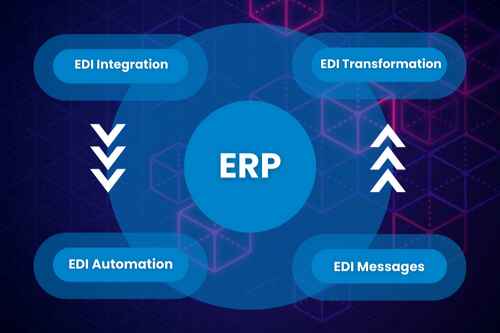
One of the major drivers of this transformation is the EDI ERP integration, which enables the direct connection of supplier, logistics, and customer transactions to business operations, thereby simplifying reconciliation while increasing accuracy and traceability. This model reframes ERP modernization as an orchestration exercise where finance, supply chain, and partner networks operate from shared information. With such connections, ERP systems become a real-time decision platform that enables automation, visibility, and predictive analytics for your business.
1. Evolving from Data Repositories to Intelligence-Driven Platforms
Traditional ERP system implementation is all about harmonizing processes. Contemporary ERP systems extend this by incorporating intelligence, AI, automation, and connectivity into business processes.
Integrated platforms establish a unified, reliable data foundation accessible across every department, enabling you to understand business performance more quickly and make decisions with greater confidence. With data silos eliminated, you get a holistic view of business, which helps in communication, eliminates redundancy, and improves planning. Research shows that ERP system integration helps centralize data, automate processes, and increase observability of business processes.
This leads to a paradigm shift in thinking, where ERP system implementation is no longer just about transaction management but about decision-making.
2. Why Integration Is the New Competitive Advantage
Speed and accuracy are the measures of competitiveness today. Integration helps you achieve both.
With ERP integration to CRM, supply chain, analytics, and partner systems, you get:
- Real-time visibility into business operations
- Seamless process flows
- Faster financial and operational closes
- Fewer manual errors
- Scalable business growth without adding more resources
Automating data transfer between systems helps reduce processing time and reduce the need for costly corrections, while real-time inventory and transaction visibility improve forecasting and decision-making.
Integration is no longer a technology boost but a business move.
3. The Rise of Ecosystem-Driven ERP
The future of ERP is ecosystem-driven. Your business is now part of an ecosystem of suppliers, logistics companies, customers, and digital partners. A full-featured ERP solution makes collaborative working in this ecosystem possible, rather than isolated execution within organizational boundaries.
The evident way to see the impact of this change is in the increasing use of EDI ERP integration, which integrates partner transactions into the very fabric of enterprise operations. When purchase orders, invoices, and shipment notifications are automatically exchanged between partners and enterprise systems, the need for human intervention is reduced, and fulfillment time is shortened. The outcome is greater accuracy, controlled operational costs, and real-time visibility into supply chain activity, enabling organizations to respond with precision instead of delay.
By taking an ecosystem perspective, you can:
- Quickly connect with new partners
- Enhance compliance and traceability
- Globalize with consistent processes
- Build business resilience in times of disruption
In this way, ERP is the enabling platform for your entire value chain.
3. Intelligent Automation and AI-Driven ERP
Integration is the basis of intelligence. After data is integrated, intelligent capabilities such as AI, machine learning, and process mining can enable predictive analytics.
The new paradigm of ERP solutions is characterized by the following:
- Event-driven processes that initiate automated actions
- Predictive demand and inventory management
- Anomaly detection in finance and operations
- Autonomous decision-making for repetitive tasks
Research studies on AI-driven ERP orchestration have demonstrated the effectiveness of machine learning triggers integrated into the overall workflow.
The takeaway for you is simple: integration is the key to autonomy.
4. Composable ERP: Flexibility without Fragmentation
Another hallmark trend is composability, which enables businesses to extend their ERP systems with modular functionality while preserving a unified data model.
Rather than extensive customization, businesses are embracing API-first design and integration platforms that enable them to build out new functionality without breaking the existing system. This enables:
- Faster innovation cycles
- Reduced upgrade complexity
- Better governance over shadow IT
- Continuous modernization rather than periodic transformation
Composable ERP helps ensure your technology environment aligns with your business plan.
Industry-Aligned ERP: Designed for Your Requirements
As your business grows beyond the constraints of one-size-fits-all solutions, the need for industry-specific ERP solutions has become more prominent. You demand solutions that are industry-regulated and industry-friendly. These platforms deliver capabilities such as:
- Industry-specific modules that help in faster implementation and reduce the need for extensive customization
- Industry-specific compliance tools that help in regulated industries such as healthcare, finance, and manufacturing
- AI-powered optimization that helps in streamlining industry-specific operations and automates reporting
5. Connected ERP: Operational Intelligence with IoT
ERP and IoT integration is revolutionizing business operations by enabling constant data capture and automated actions. As the use of sensors becomes more widespread, businesses are using ERP solutions to convert physical data into operational intelligence. The benefits include:
- Real-time asset management to track inventory, equipment, and fleet usage
- Automated supply chain operations to optimize logistics, minimize waste, and enhance forecasting
- Workplace safety monitoring to track environmental factors and support employee compliance programs in operational settings
6. Key Takeaways
- ERP solutions can turn transactional systems into strategic intelligence centers
- Real-time data integration enables quicker and more confident decision-making
- Ecosystem connectivity, including digital transaction networks, is the key to future ERP value
- AI and automation require seamless integration across processes and partners
- Composable architectures enable flexibility with governance and consistency
- Industry solutions bring ERP in line with the realities of the industry
- IoT-enabled ERP brings visibility to physical operations for real-time optimization
7. Future-Ready ERP Starts with Integration
ERP’s future belongs to organizations that treat integration as an operating principle rather than a technical upgrade. When processes, partners, and insights move through a unified environment, ERP shifts from transactional support to decision infrastructure. To accomplish this, there must be a clear understanding of architecture, sequencing, and change management, all of which are areas where ERP consulting services add measurable value. They assist you in aligning technology with the realities of your process and prevent fragmented rollouts by developing ERP systems that scale with complexity.
The outcome is not simply a connected ERP, but a resilient operational solution that adapts to new markets, evolving regulations, and continuous innovation without constant reinvention.