Hybrid and Remote Jobs in 2027: How to Show Remote Skills on Your CV
Flexible working is no longer a perk reserved for a handful of employers. Hybrid and remote roles are now a normal part of the job market, and for many professionals they are a deciding factor when choosing between offers. But competition for flexible roles is fierce, and employers want proof that you can work well without constant supervision. That proof has to appear on your CV.
This guide explains where hybrid and remote work stands going into 2027, which roles suit it best, which skills employers look for, and how to show those skills clearly on your CV and online profile.
Where Hybrid and Remote Work Stands
Across the UK, LinkedIn’s annual list of fast-growing roles shows that flexible working continues to feature widely, but hybrid models appear more often than fully remote ones, particularly in specialist and knowledge-based jobs. The practical lesson is that fully remote vacancies attract large applicant pools, while hybrid roles are more common, so many candidates will find the best opportunities in a mix of home and office working.
It also means employers are being more specific about what they need. They are less interested in whether you have worked from home and more interested in what you delivered while doing so.
Roles That Suit Hybrid and Remote Working
Jobs that rely mainly on digital tools, focused work, and written or online communication tend to adapt best. Common examples include:
- Software development, data analysis, and IT support
- Digital marketing, content, and design
- Finance, accounting, and bookkeeping
- HR, recruitment, and training
- Customer success and account management
- Project and product management
Roles that depend on physical presence, such as many healthcare, trades, and hospitality jobs, are less flexible, although administrative and coordination positions within those sectors often offer hybrid arrangements.
The Remote Skills Employers Look For
When employers hire for flexible roles, they are really testing a set of working habits. The strongest candidates can show:
- Clear written communication. Remote teams run on messages, documents, and updates, so concise, accurate writing is essential.
- Self-management. Planning your day, meeting deadlines, and prioritising without reminders.
- Digital collaboration. Confidence with video calls, shared documents, project boards, and messaging platforms.
- Reliability and ownership. Taking responsibility for outcomes and flagging problems early.
- Data and security awareness. Handling confidential information safely outside the office.
- Cross-time-zone teamwork. Useful for companies with staff in several locations.
How to Show Remote Skills on Your CV
A CV that says you are a self-motivated remote worker proves nothing. Evidence does. Follow these steps.
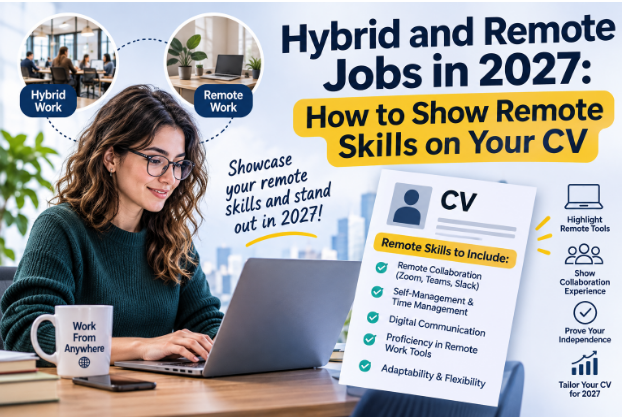
- State your working preference up front. Add a line such as Based in Manchester, open to hybrid or remote roles beneath your name. This helps recruiters and screening software understand what you are looking for.
- Describe remote experience with results. Instead of Worked remotely for two years, write Managed a client portfolio of 25 accounts remotely, achieving 96% retention across three time zones.
- List the tools you actually use. Include collaboration platforms, project management software, and any relevant systems, in a tidy skills section.
- Show how you communicate. Mention documentation you wrote, processes you improved, or meetings you led online.
- Prove independence. Highlight projects you delivered with minimal supervision and the outcome.
- Use the right keywords. Mirror terms from the job advert, such as asynchronous communication, remote collaboration, or distributed team, wherever they honestly apply.
- Keep the layout simple. Use a single column and standard headings so applicant tracking systems read your CV correctly.
If you are unsure how to phrase your experience, professional input can help. A reputable resume writing agency will ask about your remote achievements, identify which results matter most, and place them where recruiters will see them first.
Example Bullet Points
Here are examples of how remote skills can be framed:
- Led a distributed team of eight across two countries, delivering three product releases ahead of schedule.
- Created written onboarding guides that cut new-starter ramp-up time by 30%.
- Managed weekly stakeholder updates through shared dashboards, reducing status meetings by half.
- Resolved customer issues independently, maintaining a 98% satisfaction score while working remotely.
Notice that each line names an action, a context, and a measurable result. That structure works for any role and level.
Hybrid-Specific Tips
Hybrid roles add another layer, because employers want people who can switch easily between environments. Mention that you are comfortable collaborating in person on in-office days and independently on remote days. If you have experience coordinating schedules, running hybrid meetings, or supporting colleagues in different locations, include it.
Avoid Common Mistakes
A few errors regularly cost candidates interviews. Avoid vague claims with no evidence, a cluttered CV full of icons and text boxes, and generic phrases such as team player or self-starter. Do not hide your location or working hours if the employer expects them, and always tailor the CV to each vacancy rather than sending the same version everywhere.
For candidates who want a polished starting point, the best resume writing website is not necessarily the one with the flashiest templates. Look for one that offers real consultation, ATS-friendly formatting, and writers who understand your sector.
Strengthen Your Online Profile
Recruiters hiring for flexible roles often search professional networks first, so your profile needs to match your CV. Set your location and work preferences clearly, use a headline that names your role and key skills, and fill the About section with evidence of remote achievements. An experienced linkedin profile writing company can help you structure this so that recruiters searching for remote and hybrid talent can find you.
If you want a more tailored approach, a linkedin profile specialist can review your headline, keywords, and featured content, and help you present your remote experience in a way that feels natural rather than forced. Recommendations from past managers and colleagues that mention your reliability and communication also add useful proof.
Prepare for Remote-Focused Interviews
Expect questions about how you stay organised, how you handle isolation, and how you communicate when something goes wrong. Prepare two or three short stories that show you managing your time, solving a problem independently, and keeping colleagues informed. Test your camera, microphone, and connection before video interviews, and choose a quiet, tidy background.
Final Thoughts
Hybrid and remote jobs will remain a major feature of the 2027 job market, but the competition for them rewards candidates who can prove they work well outside the office. Present your experience with clear results, show the habits and tools that make remote work succeed, and keep your CV and online profile consistent. For personalised guidance on the profile side, a linkedin profile consultant can help you turn that evidence into more interviews for the flexible roles you want.