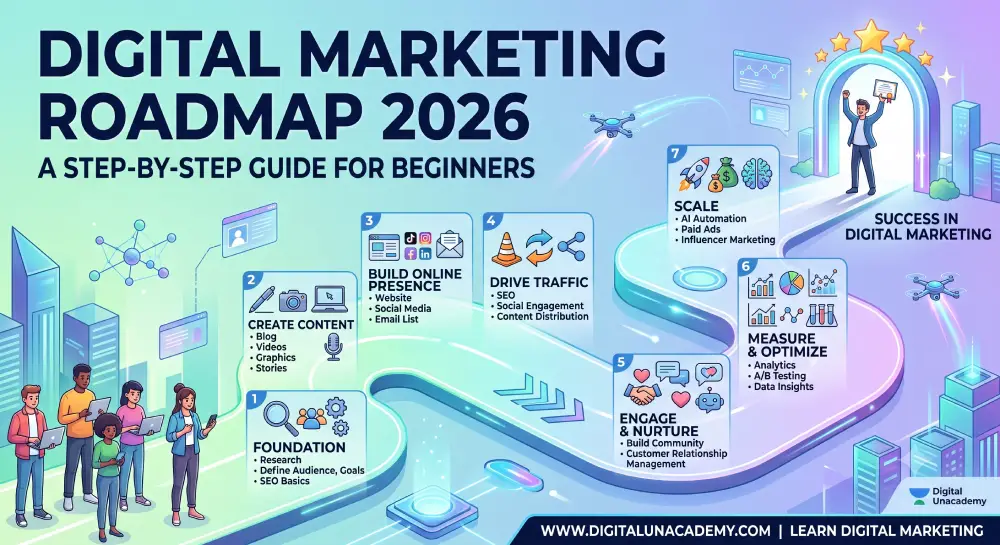
Digital marketing in 2026 looks very different from what it did even three years ago. AI tools now handle tasks that used to take a full team, search engines reward genuine expertise over keyword tricks, and customers expect brands to show up across a dozen platforms at once. If you’re starting from zero, that can feel overwhelming. This roadmap breaks the whole field down into a clear order: what to learn first, what to skip until later, and how to actually prove your skills to an employer or client.
Traditional marketing relied on billboards, print ads, and cold calls, channels where you paid for attention and hoped it converted. Digital marketing flips that model. You can measure exactly which ad, email, or blog post brought in a sale, and you can adjust your approach within hours instead of waiting for the next print run. That shift is why so many people are moving into this field, and why having a structured plan matters more than randomly watching tutorials.
This guide covers what digital marketing actually involves, the specific skills worth building in 2026, a step-by-step learning path, the tools you’ll need, realistic timelines, and how to get practical experience even before you land your first job.
What Is Digital Marketing?
Digital marketing is the practice of promoting products, services, or brands using online channels. It’s not one skill but a collection of related disciplines that work together:
- SEO (Search Engine Optimization): Getting web pages to rank higher in search results so people find them organically.
- Content Marketing: Creating blog posts, videos, guides, and other material that attracts and educates an audience.
- Social Media Marketing: Building a brand presence and engaging audiences on platforms like Instagram, LinkedIn, and YouTube.
- PPC (Pay-Per-Click Advertising): Running paid ads on Google, Meta, or other platforms where you pay only when someone clicks.
- Email Marketing: Nurturing leads and customers through targeted email campaigns.
- Affiliate Marketing: Partnering with other creators or websites who promote your product for a commission.
- Analytics: Measuring what’s working using tools like Google Analytics to guide decisions with data instead of guesswork.
- AI-Powered Marketing: Using AI tools for content creation, ad optimization, customer segmentation, and campaign automation.
Most marketers eventually specialize in one or two of these areas, but understanding how all of them fit together is what makes a beginner job-ready.
Digital Marketing Skills You Need in 2026
SEO
SEO is still the backbone of long-term, low-cost traffic. In 2026, it also means understanding how AI-driven search results and answer engines pull information, since a growing share of searches never result in a click to your website at all. Beginners should learn keyword research, on-page optimization, technical SEO basics like site speed and mobile-friendliness, and how backlinks influence rankings.
Content Marketing
Content marketing is about creating material that solves a real problem for your audience: blog posts, videos, infographics, or downloadable guides. The skill here isn’t just writing; it’s understanding what your audience is actually searching for and structuring content so it answers that question clearly.
Google Ads/PPC
Paid advertising skills let you generate traffic immediately rather than waiting months for organic rankings to build. You’ll need to learn how to set up campaigns, structure ad groups, write compelling ad copy, and manage a budget without overspending on clicks that don’t convert.
Social Media Marketing
Each platform has its own culture and content style. What works on LinkedIn rarely works on Instagram. Beginners should focus on understanding platform algorithms, content formats like Reels and Shorts, and how to build genuine engagement rather than chasing vanity metrics like follower counts.
Email Marketing
Email remains one of the highest-return channels in digital marketing because you own your list, unlike a social media following that can disappear overnight if an algorithm changes. Learn how to build sequences, segment audiences, and write subject lines that actually get opened.
Analytics
If you can’t measure a campaign, you can’t improve it. Learning to read dashboards in Google Analytics, interpret conversion data, and connect marketing activity to actual business outcomes is what separates marketers who guess from marketers who know.
AI and Automation
AI tools can draft content, generate ad variations, analyze customer data, and automate repetitive tasks like scheduling posts or sorting leads. Employers in 2026 increasingly expect candidates to know how to use these tools responsibly, meaning you understand their limitations and still apply human judgment to strategy and quality control.
Step-by-Step Digital Marketing Roadmap
- Learn marketing fundamentals. Understand basic concepts like target audience, buyer personas, the marketing funnel, and branding before touching any specific channel.
- Learn SEO. Start with keyword research and on-page basics, then move into technical SEO once you’re comfortable.
- Learn content marketing. Practice writing for different formats and learn how to structure content around search intent.
- Learn social media. Pick two or three platforms relevant to your target industry and study their specific best practices.
- Learn Google Ads. Set up a small test campaign, even with a minimal budget, to understand how the platform actually works.
- Learn analytics. Get comfortable with Google Analytics and basic reporting so you can back up your work with data.
- Learn email marketing. Try building a sequence using a free-tier tool like Mailchimp or MailerLite.
- Learn AI marketing tools. Experiment with AI writing assistants, ad generators, and automation platforms to see where they genuinely save time.
- Build projects. Apply what you’ve learned to a real or simulated business so you have tangible examples of your work.
- Create a portfolio. Document your projects, including your process and results, in a format you can share with employers or clients.
- Apply for internships or jobs. Start applying once you have a portfolio, even if you don’t feel fully ready. Most learning happens on the job.
- Continue developing advanced skills. Digital marketing evolves constantly, so treat learning as ongoing rather than something you finish once.
Best Digital Marketing Tools for Beginners
You don’t need an expensive toolkit to get started. Free or low-cost tools like Google Analytics, Google Search Console, Canva, Ubersuggest, and Mailchimp cover most of what a beginner needs to practice real skills. For a full breakdown of tools by category and which ones are worth paying for as you advance, see our detailed guide on digital marketing tools for beginners.
How Long Does It Take to Learn Digital Marketing?
Most beginners can learn the fundamentals of digital marketing in three to six months with consistent, focused study. That timeline covers the basics of SEO, content, social media, and analytics well enough to start freelancing or applying for entry-level roles. Becoming genuinely skilled across multiple channels, the kind of expertise that commands a higher salary, typically takes one to two years of hands-on experience. The people who progress fastest aren’t necessarily the ones who study the most; they’re the ones who apply what they learn to real projects along the way.
How to Practise Digital Marketing Without a Job
You don’t need to wait for an employer to start building real experience.
- Start a blog. Pick a niche you’re genuinely interested in and practice applying SEO and content principles to it.
- Build a test website. Use a free platform to create a small site where you can experiment with on-page SEO and site structure.
- Run a small campaign. Even a five-dollar Google or Meta ad campaign will teach you more than reading ten articles about PPC.
- Perform keyword research. Pick any business, real or hypothetical, and map out what keywords they should be targeting.
- Create social campaigns. Design a week’s worth of content for a fictional brand to practice planning and consistency.
- Analyse competitors. Study what successful websites and social accounts in a niche are doing well and write up your findings.
Each of these becomes a portfolio piece you can show during interviews, which matters far more to most employers than a certificate alone.
Digital Marketing Career Options
Digital marketing offers a wide range of career paths, from SEO specialist and content strategist to paid media manager, social media manager, and marketing analyst. Some people move toward generalist roles that touch every channel, while others specialize deeply in one area. For a closer look at specific roles, expected responsibilities, and how to position yourself for each, read our guide on digital marketing jobs.
Digital Marketing Courses vs Self-Learning
Both paths can work, and the right choice depends on how you learn best and how much structure you need. Courses offer a guided curriculum, deadlines, and often a community or mentor to keep you accountable. Self-learning is more flexible and usually cheaper, but it requires more discipline to stay consistent and to know which resources are actually worth your time. We compare both approaches in detail, including which one tends to lead to faster job placement, in our article on digital marketing courses.
Common Mistakes Beginners Should Avoid
Many beginners try to learn every channel at once instead of building depth in one or two areas first, which leaves them with surface-level knowledge across the board and no real expertise anywhere. Others skip analytics entirely because it feels less exciting than content or ads, then struggle to explain results in interviews. A common trap is also treating certificates as proof of skill rather than building actual projects; employers care far more about what you’ve done than what you’ve completed. Finally, many beginners give up on SEO too early because it doesn’t show quick results, not realizing that patience with organic growth is part of the skill itself.
Frequently Asked Questions
Can I learn digital marketing in 3 months? You can learn the fundamentals of two or three channels in three months if you study consistently and apply what you learn through small projects. Full proficiency across multiple disciplines usually takes longer.
Is digital marketing a good career in 2026? Digital marketing continues to be in demand as businesses shift more of their budgets online. Roles that combine traditional marketing skills with AI tool proficiency are especially sought after.
Which digital marketing skill should I learn first? SEO and content marketing are a strong starting point because they teach you how search engines and audiences think, which makes every other channel easier to understand afterward.
Is coding required? No. Basic HTML knowledge helps with technical SEO tasks, but you don’t need to know how to code to become a successful digital marketer.
Can I learn digital marketing without a degree? Yes. Digital marketing is one of the more accessible fields to break into without a formal degree, since employers and clients generally care more about demonstrated skills and results than academic credentials.