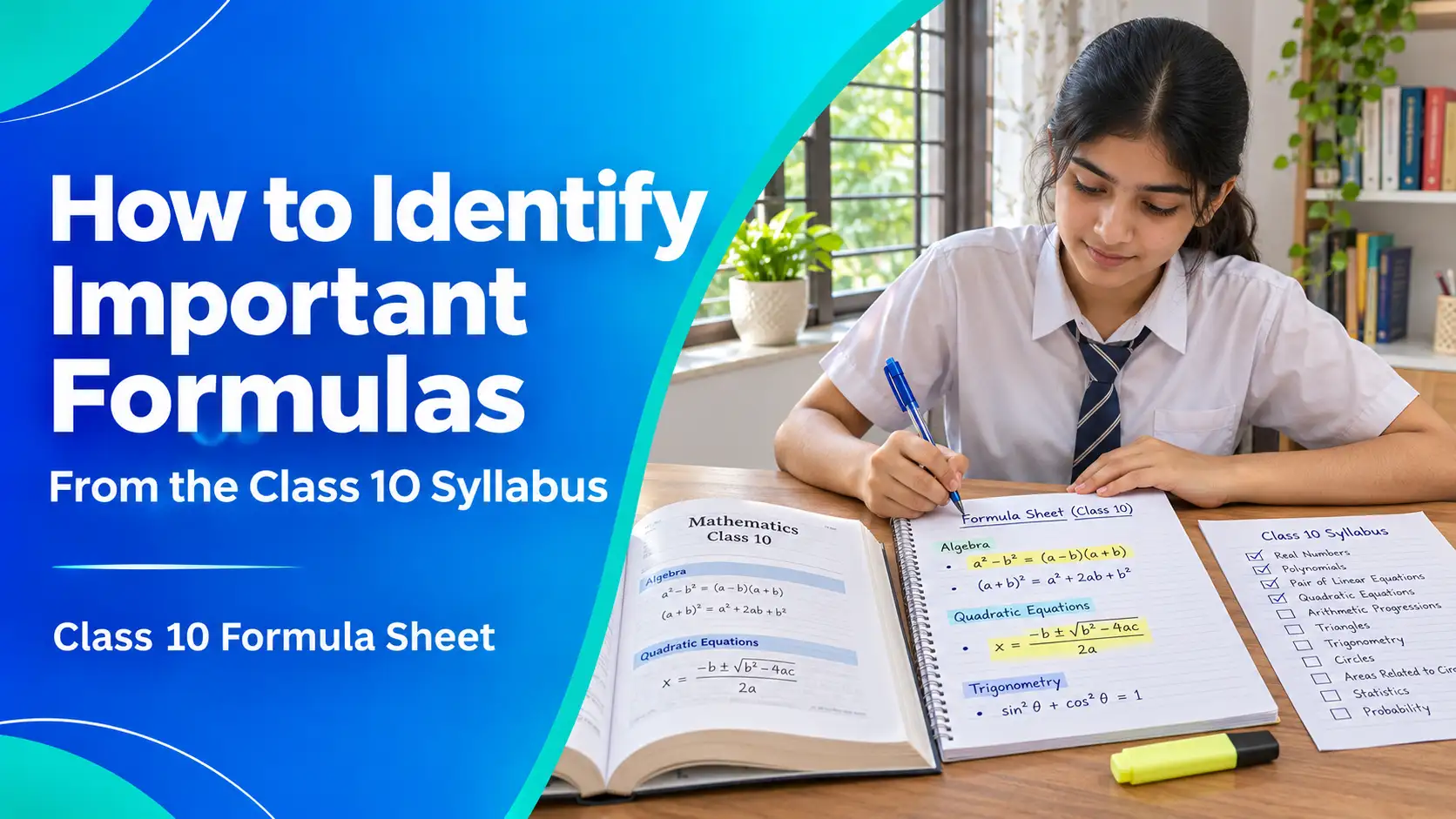
If there is something students struggle with the most in the Class 10 syllabus of Mathematics and Science, that would definitely be formulas. There are dozens of them in any textbook of these subjects, and the most natural response for any student is trying to remember all of them. That is both useless and unnecessary, though. Not all formulas are equally important for the examination, and the students who manage to score high marks are the ones who know how to distinguish the important formulas from others.
So how do you know which formulas are more important? This article will tell you the three major signs you should look for in the syllabus, as well as how to create your own Class 10 Formula Sheet, and what mistakes you should avoid along the way.
1. How to Identify the Most Important Formulas – Signs
There are three signs in the syllabus you should pay attention to while determining the importance of formulas.
Signal 1: Check the marks (unit-wise weightage)
First of all, you should check the marks each unit carries in the syllabus. CBSE provides the unit-wise weightage of marks for Class 10 Maths syllabus as follows:
| Unit | Marks (/80) |
| Algebra | 20 |
| Geometry | 15 |
| Trigonometry | 12 |
| Statistics & Probability | 11 |
| Mensuration | 10 |
| Number Systems | 6 |
| Coordinate Geometry | 6 |
(Verify the current weightage from the official CBSE syllabus, as it may vary from time to time.)
As you can see from this table, the first four units account for the vast majority of the exam. So it goes without saying that the formulas from these units are the ones that are more likely to be tested in the exam, and therefore you should try to memorise them first.
Signal 2: See how the formulas repeat in previous year papers
Knowing the marks each unit carries helps you understand which of the units you should pay more attention to. But even inside one unit, there may be some formulas that are tested much more frequently in the exam than others. You should check the previous year papers, and you will easily see which formulas appear in almost each year.
For example, in Class 10 Maths, the following formulas appear in the vast majority of previous papers: the distance and section formulas in Coordinate Geometry, the mean/median/mode formulas for grouped data, the area of a sector and segment in Mensuration. (If you are a student of another educational board, the same trick works for you as well; for instance, the students of the NIOS Board can use this method with the help of general NIOS board exam study tips.) Checking this information is much more reliable than relying on the “important formulas” list someone gives you.
Signal 3: See which formulas are used in NCERT textbooks
This is a sign that many students ignore. But the thing is that the CBSE papers are strongly based on NCERT textbooks, and therefore the formulas that appear in many examples and exercises of NCERT books are most probably the formulas that may be tested in the exam. And if the textbook makes you solve a formula multiple times, that is no coincidence – that is the hint.
2. How to Differentiate the Important Formulas – Separating the Core Formulas and Derived Ones
Having found the important formulas, you should divide them into two categories.
“Core” formulas are the formulas that you are supposed to know instantly – e.g. formulas of sine and cosine, quadratic formulas, basic formulas of the area and volume, etc. Memorize these formulas.
Derived formulas are the formulas that can be constructed using the “core” formulas in case you know the logic behind them. Therefore, it is more efficient to learn them not just by heart but also to understand the principle of their functioning – then if you forget a formula, you will be able to reconstruct it.
It also means that formulas of Science should be understood rather than crammed – that is also tested in the exam.
3. Creating Your Formula Sheet
Based on these principles, create your own formula sheet that you can keep close to you during the exam (depending on the regulations). It will contain the formulas sorted by chapter, the formulas of high weightage and high frequency being placed on top. Creating the formula sheet is the kind of revision itself, and your own created sheet is much more memorable than the one you have found somewhere else.
Alternatively, if you want to create the sheet starting from a ready reference, a consolidated formula sheet of Class 10 is a good choice – you may simply pull the formulas that correspond to your weak units and high-weightage chapters from it. The purpose of creating the sheet is not listing all the formulas of the textbook, but having the important ones always in front of you.
Do not just memorise the formulas, but also learn how to use them
It is very easy to think that learning a formula and being able to use it are the same thing. Actually, the latter is tested in the examination much more frequently than the former. For example, a question never asks you to use such a formula as a section formula directly – it asks you about a situation, and you are supposed to understand which formula suits that situation.
And in order to be able to use the formulas correctly and quickly, you have to solve many varied problems. Start solving plenty of application problems, and as you get promoted to higher classes, you may try solving the problems from question banks such as CBSE Class 12 Question Bank.
4. Common Mistake to Avoid
The most common mistake students commit in this case is trying to memorize all the formulas from the textbook the day before the exam – you will just get overloaded and confused, forgetting all the formulas in the process. Instead, you should prioritize the formulas according to the marks and frequency, master the core formulas first, and understand the derived ones. The focused formula sheet will be much more helpful for you than the attempt to remember all of the formulas.
5. FAQ
How do I know which formulas of Class 10 are the most important?
Use the three signs – unit-wise weightage, formulas appearing frequently in previous year papers, and formulas used frequently in NCERT textbook.
Which units of Class 10 Maths carry the most marks?
Right now, they are Algebra (20), Geometry (15), Trigonometry (12), Statistics & Probability (11), and Mensuration (10). Verify on the official syllabus.
Should I memorise or understand the formulas?
Both – memorise the core formulas, and understand the derived ones.
How do I make a good formula sheet?
Sort the formulas by chapter, put the most important formulas on top, and make your own formula sheet starting from the textbook and reference formula sheet.
Does memorising the formulas guarantee good marks?
No – you also need to learn how to use the formulas. Solve various application problems in order to be able to use the formulas quickly.
Is this approach relevant for the Science formulas as well?
Yes – prioritise the formulas, and understand how to apply them.